
Marriage Biodata Photo Guide
Marriage Biodata Profile Pic & Photo Guide for India
How to choose photos that look polished, current and unmistakably like you, with real marriage biodata profile pic examples, pose guidance, print specs, AI editing advice and privacy tips for Indian men and women.
July 15, 2026 | 14 min read | PhotoReady Editorial Team
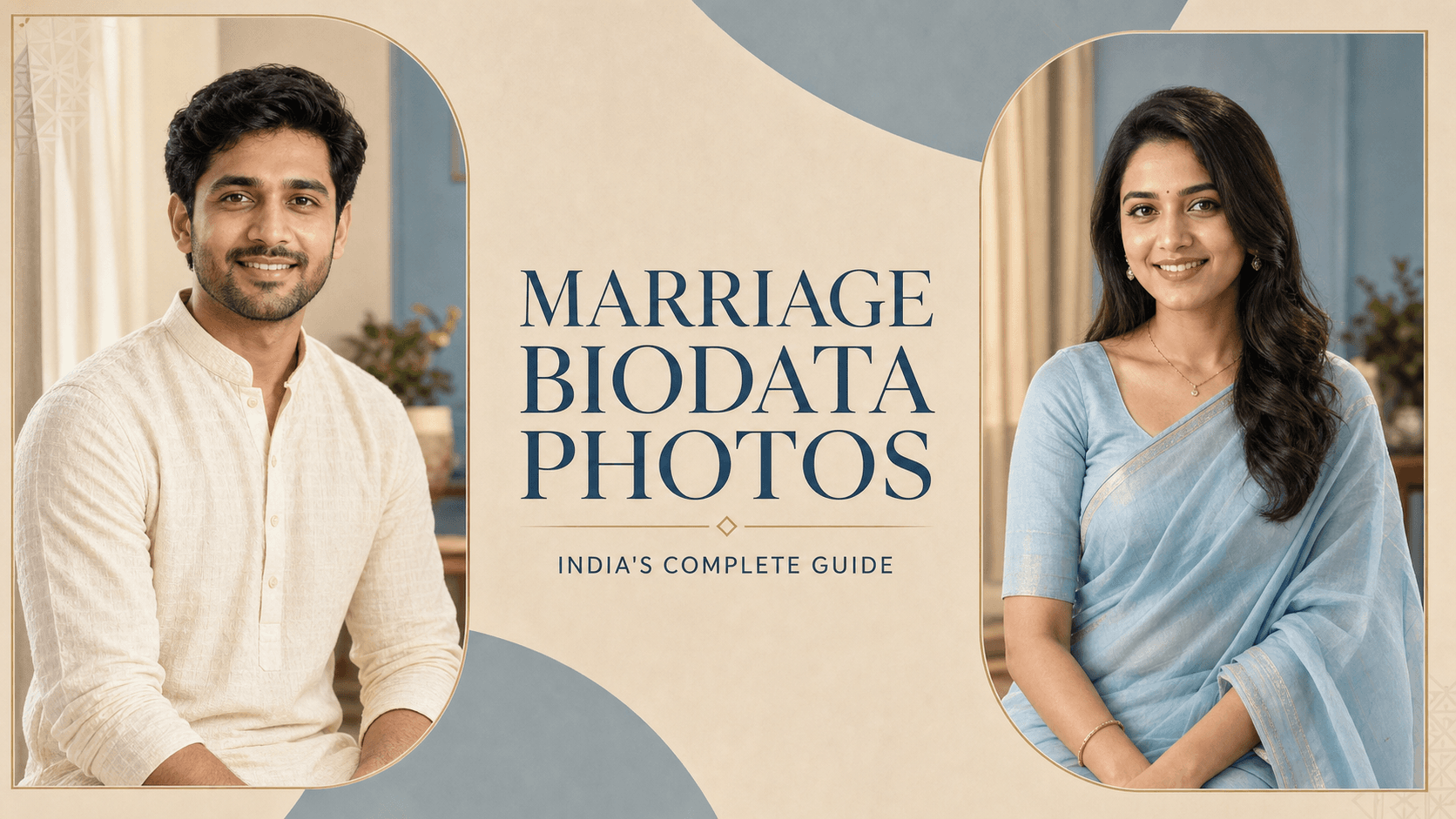
Quick answer: the best marriage biodata profile pic
The best marriage biodata profile pic is a recent, clear and truthful portrait in which you look comfortable. Use soft light, an eye-level camera, a quiet background, well-fitted clothes you would genuinely wear and a small natural smile. Start with one head-and-shoulders image; add a three-quarter, full-length and relaxed lifestyle photo when space allows.
Your goal is not to look like a different person or satisfy every family's idea of “traditional.” Your goal is to make recognition, trust and a meaningful first conversation easier.
Ready to apply these principles? Explore 30 marriage biodata prompts and photo examples for Indian men and women, then choose the look that feels most like you.
Visual examples
Marriage biodata profile pic examples: what good looks like
A photo guide needs examples because small differences in angle, lighting and background change the feeling completely. These are article examples, not promises that every face or outfit should look identical. The principle is simple: clear face, honest likeness, soft light and a background that does not compete with you.
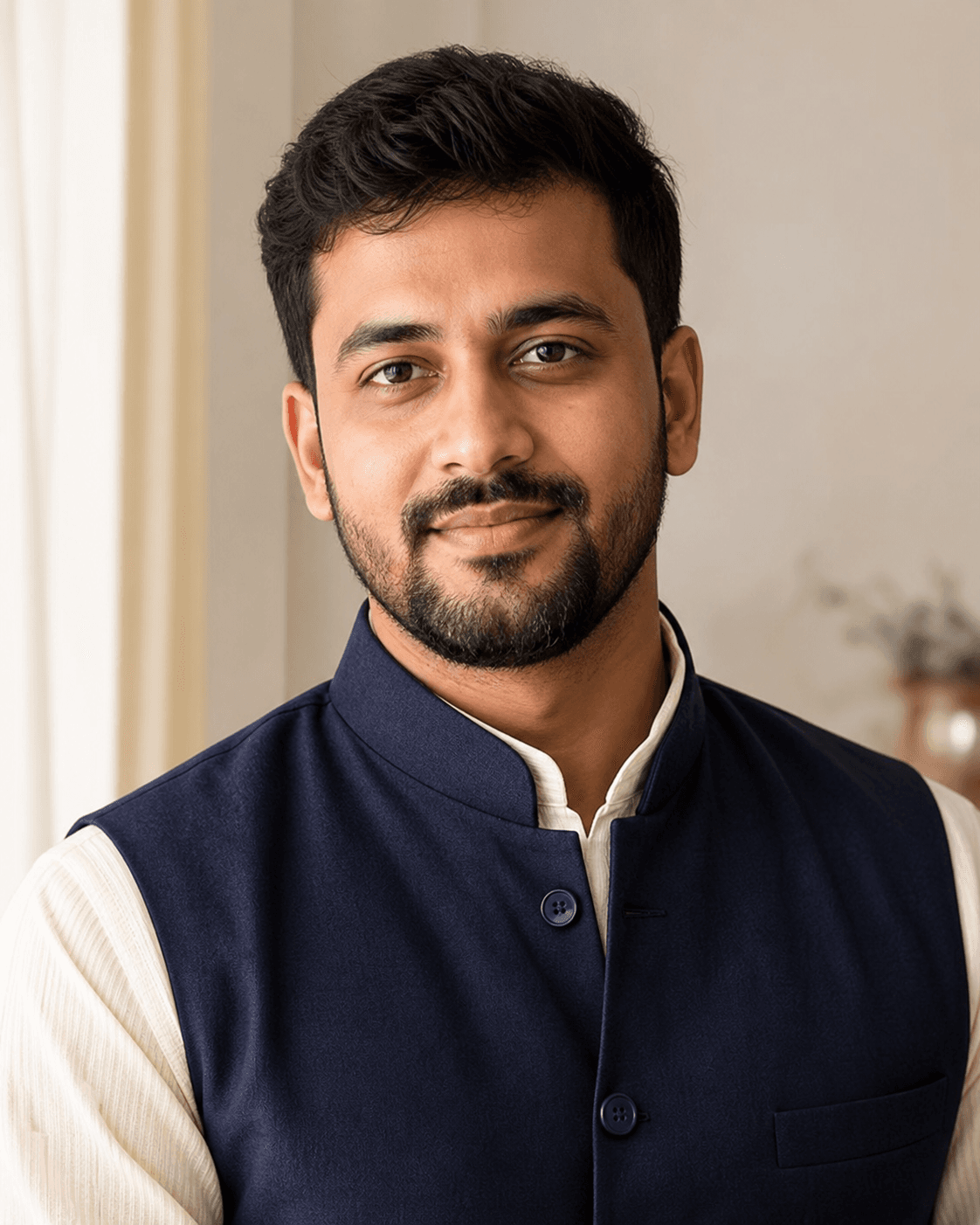
Men's biodata profile pic
A clean head-and-shoulders portrait with eye-level framing, natural expression, soft daylight and a polished Indian formal outfit.
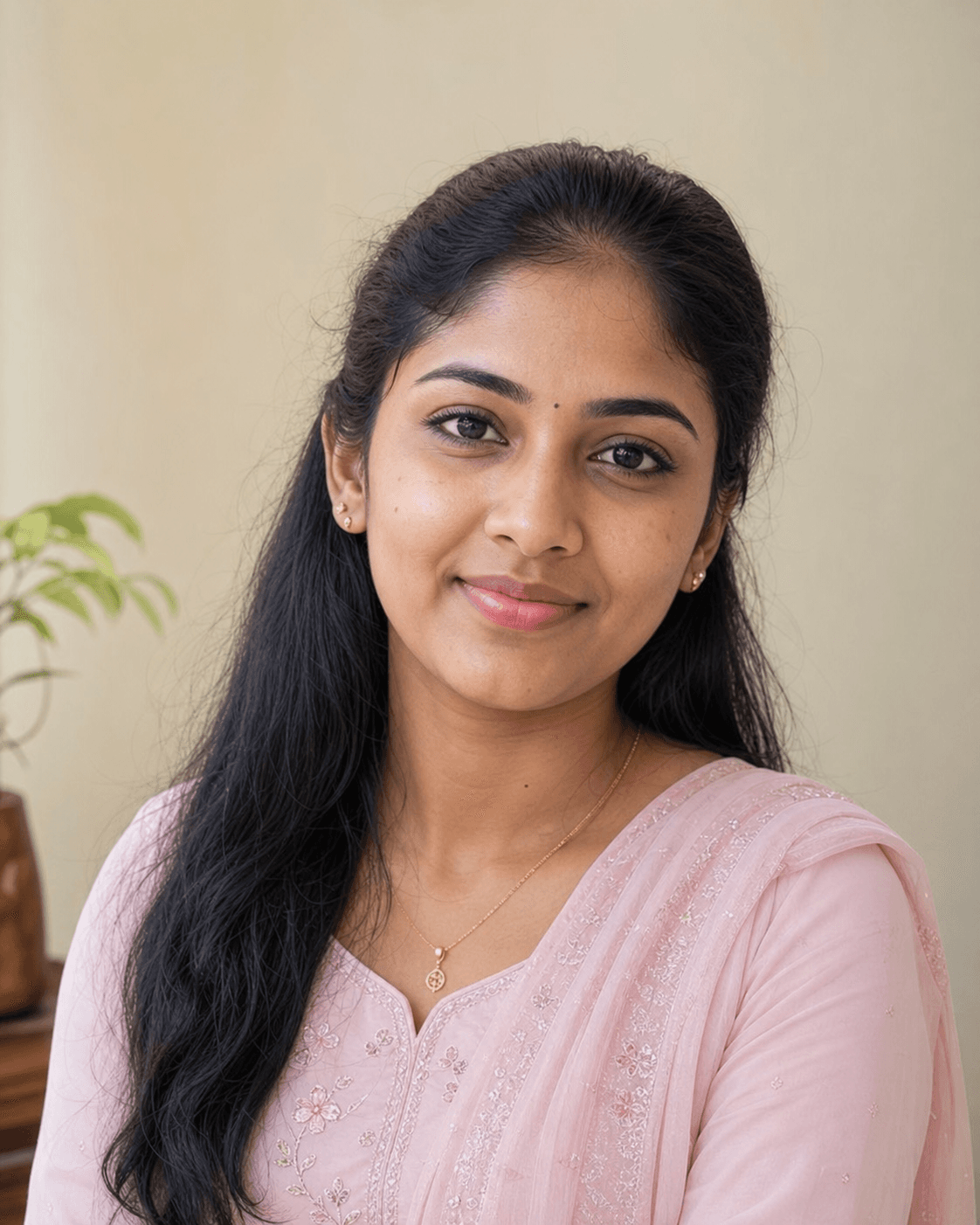
Women's biodata profile pic
A warm, current and realistic portrait with simple jewellery, visible eyes, natural skin texture and no heavy bridal styling.
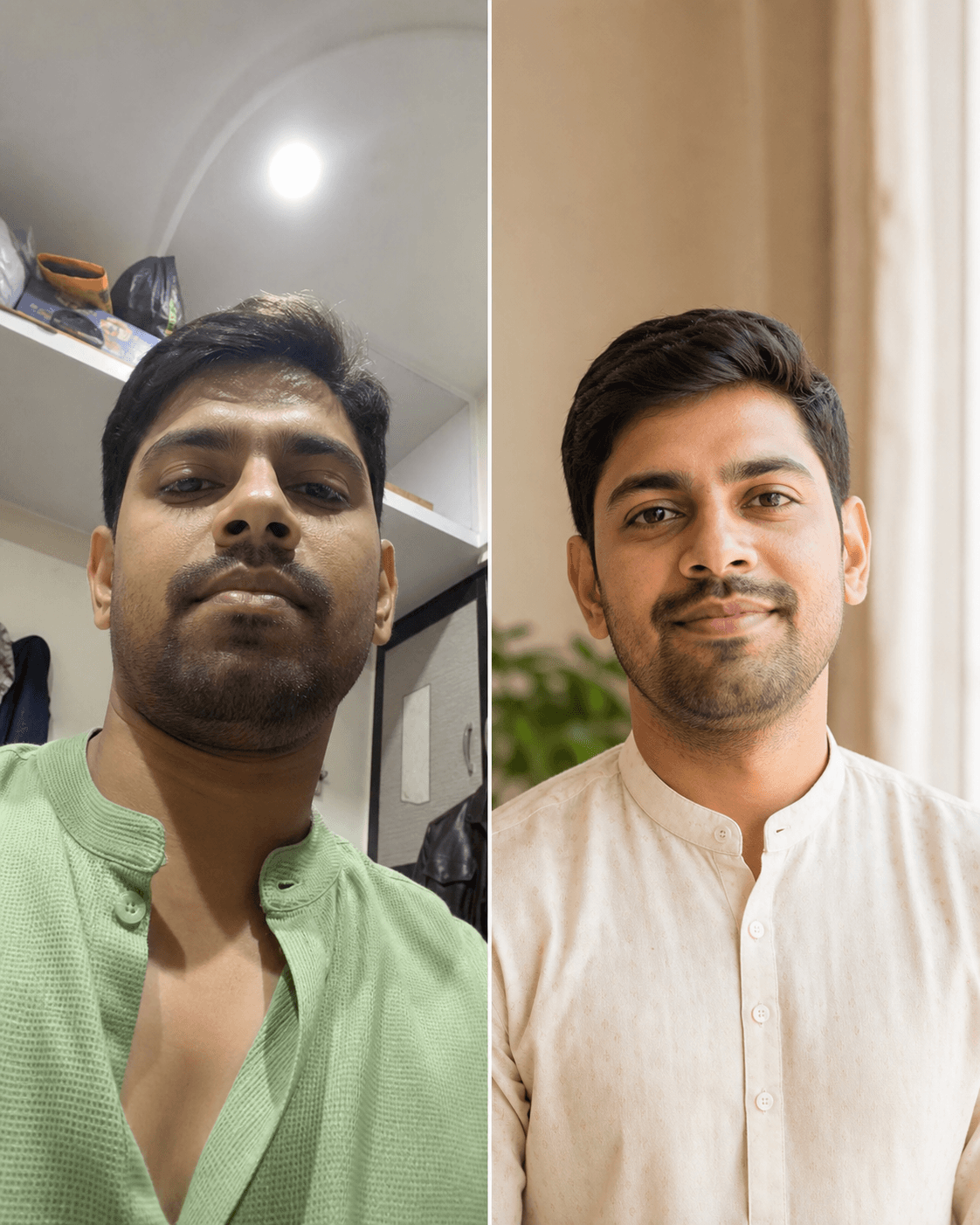
Bad selfie vs strong biodata photo
The strongest improvement is not glamour. It is eye-level framing, softer light, a quieter setting and a face that still looks like the same person in real life.
Start here
Use a small photo set, not ten versions of the same selfie
A one-page biodata needs one excellent photograph. A digital matrimony profile or longer PDF benefits from three or four images that answer different questions. Together they should show your face, posture, personal style and normal presence without turning the biodata into a modelling portfolio.
Clear head-and-shoulders portrait
Your primary biodata image. Look into the camera, keep both eyes visible and use a natural expression. This is the photo that should still work when displayed small inside a PDF or WhatsApp preview.
Three-quarter portrait
Frame from roughly the waist or mid-thigh upward, with your body turned slightly and your face returning toward the camera. It communicates posture, personal style and confidence without feeling like a passport photograph.
Full-length photograph
Use a simple standing pose and an uncluttered setting. This should show you naturally, not exaggerate height or body shape with a low camera angle, wide lens or aggressive retouching.
Optional lifestyle portrait
Add one relaxed image that feels like your real life: reading on a balcony, walking in a garden, sitting in a calm café or wearing regional attire at home. Keep your face clear and avoid group-event crops.
Marriage biodata photos for Indian men
Men are often told only to “wear a formal shirt and stand straight.” That produces stiff pictures. A better portrait balances structure with warmth: clean lines in the outfit, relaxed shoulders, engaged eyes and an expression that suggests you are comfortable meeting someone—not attending an interview.
What usually works
- A light blue, ivory, sage, dusty pink or white shirt with a clean collar
- A solid kurta in cotton, linen or understated jacquard
- A well-fitted blazer or Nehru jacket when it feels like your normal formal style
- Neat hair and facial hair with edges groomed a day before the shoot
- A simple watch or subtle accessory rather than multiple statement pieces
What weakens the photograph
- Gym selfies, sunglasses, car selfies and cropped vacation photos
- A tie pulled too tight, a jacket that bunches at the shoulders or an unironed kurta
- Hands pressed flat against the thighs and shoulders held unnaturally high
- Very wide phone-camera framing that makes the face or torso look distorted
- An expression so serious that it reads as tense or unapproachable
For the primary portrait, angle your torso about 15–30 degrees, return your face toward the lens and keep your weight balanced. For a full-length photograph, place one foot slightly ahead, let one arm rest naturally or lightly adjust a cuff, and keep the camera around chest-to-waist height. Avoid pushing the chin upward; move it a little forward and down instead.
Marriage biodata photos for Indian women
A woman's biodata photograph does not have to imitate a bridal portrait. The strongest image communicates personality and comfort. Sarees and salwar suits photograph beautifully, but so do kurta sets, modest dresses, shirts and blazers. Choose the version of yourself you would be happy for someone to meet in real life.
What usually works
- A solid or lightly textured saree, salwar suit, kurta set or well-cut western formal outfit
- A neckline and drape that remain comfortable when sitting and standing
- Makeup consistent with your usual preference—from none to polished—but with real skin texture
- Small earrings, a fine chain, watch, bindi, hijab or regional details that genuinely represent you
- Hair arranged so both eyes and the shape of the face remain visible
What weakens the photograph
- Heavy bridal styling when the photo is meant to show everyday appearance
- Beauty filters that lighten skin, enlarge eyes or reshape the jaw and nose
- A dupatta, saree pallu or hair placement that needs constant adjustment
- Overhead room lighting that creates shadows beneath the eyes
- Forced “feminine” poses that feel unlike your normal body language
For a three-quarter portrait, turn your body slightly, keep the shoulder nearest the camera relaxed and bring your face gently back toward the lens. Hands can rest loosely together, touch the edge of a dupatta or sit naturally on your lap. Avoid crushing the upper arms against the torso; a small amount of space creates a more relaxed silhouette without artificial body editing.
Clothing guide
The best outfit is polished, recognisable and yours
Fit and colour harmony matter more than whether an outfit is Indian or western. Test the clothes while sitting as well as standing, steam visible creases and photograph a quick phone preview before the main shoot. Tiny checks, dense stripes and reflective embroidery can shimmer or lose detail after a biodata PDF is compressed.
| Look | Strong choices | Best setting | Watch for |
|---|---|---|---|
| Indian classic | Kurta, saree, salwar or coordinated kurta set | Warm neutral wall, veranda or refined home interior | Overly bridal details and bulky draping |
| Professional | Shirt, blazer, suit, formal dress or smart separates | Soft grey, beige or clean office-like interior | Looking like an ID card or corporate badge photo |
| Regional | Authentic local weave, silhouette or cultural accessory | Simple architecture or interior connected to the look | Turning personal culture into costume |
| Relaxed lifestyle | Solid polo, linen shirt, simple kurti, dress or coordinated casuals | Balcony, garden, café or daylight home setting | Logos, athleisure and holiday-photo clutter |
Reliable colours
Ivory, navy, teal, sage, maroon, rust, powder blue, dusty rose and other controlled jewel or earth tones.
Use contrast
Do not wear the same tone as the wall. Light clothing needs a slightly deeper background; dark clothing needs separation light.
Respect skin tone
Choose colours that make your face look lively in neutral daylight. Never lighten skin to match an outdated matrimonial ideal.
Pose without pretending
Five poses that work for real people
The open front portrait
Face the lens, turn the shoulders only a few degrees, lower them away from the ears and breathe out before the shutter. Best for the main image.
The gentle three-quarter
Turn the body 20–35 degrees while keeping the eyes toward the camera. It adds dimension without hiding half the face.
The supported seated pose
Sit near the front of a firm chair, lengthen the spine and rest hands lightly on the lap or armrest. Do not lean deep into a sofa.
The natural standing pose
Shift slightly more weight to the back leg, soften the front knee and give both hands a simple job—one at a cuff, pocket edge, dupatta or relaxed at the side.
The slow walking portrait
Take two or three slow steps toward or across the camera and look up after the first step. Use this only as a supporting lifestyle image.
Expression cue: Do not hold a smile for thirty photographs. Look away, exhale, return your eyes to the lens and think of greeting someone you are genuinely pleased to meet. Ask the photographer to shoot the moment before and after the full smile; those frames often feel most natural.
How to take a professional biodata photo at home
A recent phone with good light can beat an expensive camera used badly. Ask another person to take the photographs; avoid holding the phone yourself. Clean the lens first—the soft haze people blame on the camera is often a fingerprint.
- 1
Find soft light
Stand about one metre from a large window with indirect daylight. Turn slightly until both eyes are bright. Switch off harsh ceiling lights that mix orange and blue colour.
- 2
Build distance
Place the phone roughly 2–3 metres away and zoom modestly if the camera remains sharp. Do not use the ultra-wide lens. Distance produces more natural facial proportions.
- 3
Set camera height
For headshots, keep the lens at eye level. For full-length images, lower it to around waist or mid-torso height while keeping the phone vertical—not tilted dramatically upward.
- 4
Use a simple background
Leave some distance between you and the wall. Remove switches, bags, cables, calendars and bright objects that pull attention away from the face.
- 5
Shoot complete sequences
Take 10–15 frames per pose while making tiny changes to expression, chin and shoulders. Review sharpness by zooming into the eyes before changing outfit or location.
- 6
Export carefully
Keep the original file. For digital biodata, use a portrait crop around 1200 × 1600 pixels or larger, sRGB colour and high-quality JPEG or PNG. Do not repeatedly forward the image through WhatsApp before placing it in the PDF.
Print specs
Marriage biodata photo size, DPI and A4 print rules
Biodata maker tools and family-shared PDFs often shrink your photo into a small box on an A4 page. That means the original image must be clean before compression. Keep a high-resolution original and export a separate viewing copy for WhatsApp.
| Use case | Recommended spec | Why it matters |
|---|---|---|
| Digital biodata PDF | 1200 × 1600 px or larger, 3:4 or 4:5 crop, sRGB JPEG/PNG | Stays sharp in previews and survives moderate PDF compression. |
| A4 print biodata | Keep 300 DPI available; display around 3.5 × 4.5 cm when placed in layout | Small printed portraits need sharp eyes and clean edges. |
| Minimum safe crop | About 600 × 800 px for the placed photo box | Gives headroom beyond the rough 420 × 540 px needed for 3.5 × 4.5 cm at 300 DPI. |
| Avoid | Screenshots, repeatedly forwarded WhatsApp copies, compressed social uploads | They soften eyes and skin texture before the biodata maker compresses again. |
Using AI for biodata photos—without losing trust
AI is useful when it improves presentation, not identity. A good AI result should look like a photograph you could realistically have taken that week. The person meeting you should recognise you immediately.
Helpful AI use
- Correct uneven lighting and colour balance
- Remove temporary background clutter
- Improve crop, resolution and print readiness
- Create a restrained studio-style background
- Generate a polished marriage biodata profile pic while preserving identity
Misleading AI use
- Lightening or changing natural skin tone
- Reshaping the face, nose, jaw or body
- Changing age, hairline, height or build
- Adding luxury settings intended to imply lifestyle or wealth
- Using a synthetic image as the only recent photograph
Four useful AI example directions
Neutral studio portrait
Preserve facial identity and natural skin texture; eye-level head-and-shoulders portrait; warm off-white studio; soft window light; realistic 85mm photography; gentle expression.
Indian formal portrait
Preserve identity; refined solid kurta or saree; minimal accessories; muted interior; relaxed three-quarter pose; honest proportions; premium natural portrait photography.
Professional contemporary portrait
Preserve identity; well-fitted blazer or smart formal outfit; soft grey background; approachable expression; clean light; no beauty filter; realistic detail.
Natural lifestyle portrait
Preserve identity; simple coordinated clothing; shaded garden or calm balcony; subtle walking or seated pose; natural daylight; realistic Indian setting; no luxury staging.
PhotoReady recommendation: keep one authentic camera photograph as the primary image. If you use a fully AI-generated scene as a supporting example, disclose that when the context could otherwise create a false impression.
India nuance
Regional and community expectations vary, so make the photo feel intentional
Indian marriage biodata photos are not one national template. Families may expect different levels of formality, modesty, regional dress, jewellery, head covering, religious markers or language-specific layouts. The safest rule is not to copy another community's styling; choose details that are true for you and understandable for the audience receiving the biodata.
North and West India
Kurtas, sarees, salwar suits, Nehru jackets, blazers and clean home interiors often work well. Avoid turning the biodata photo into a full wedding look unless that is expected.
South India
Simple sarees, kurta sets, shirts, veshti-inspired formals or restrained jewellery can photograph beautifully. Keep the face clear and avoid overly busy temple or event backgrounds.
Muslim biodata sharing
Hijab, kurta, sherwani-inspired details or modest formal wear can be appropriate when authentic. Lighting and expression still matter more than heavy styling.
Language variants
If you later make Hindi, Marathi, Gujarati, Tamil, Telugu, Kannada or Urdu biodata pages, reuse the same photo principles but localise examples, captions and dress notes.
Privacy choice
A no-photo marriage biodata can still be valid
Some families and candidates deliberately send biodata without a photo at the first stage. That can be a reasonable privacy choice, especially when the biodata is moving through extended family WhatsApp groups. If you skip the photo, make the layout look complete with strong personal details, education, work, family context and preferences. Share a recent marriage biodata profile pic later, after basic interest and consent are clear.
Final selection
Choose for recognition, not maximum glamour
Do not select only by asking “Which photo makes me look best?” Ask which one looks most like you on a good day. Review the photographs at both full size and thumbnail size, because the main biodata image is often displayed quite small.
The six-question test
Ask two people for feedback: one who knows you well and one who can be objective about photographic quality. Do not outsource the final choice entirely to relatives. It is your biodata, and you should feel accurately represented by it.
Privacy matters when photos travel through families and WhatsApp
Matrimonial photographs can move beyond the person you originally sent them to. Treat distribution as a privacy decision, not only a design decision.
- Share a lower-resolution viewing copy while keeping the high-resolution original private.
- Avoid visible house numbers, office badges, vehicle plates, certificates and location clues.
- Remove location metadata when exporting from your phone or editing application.
- Use a dedicated biodata PDF instead of forwarding loose original photographs when possible.
- Ask before sharing another person's image or using a crop from a group photograph.
- Keep intimate, highly personal and home-interior images out of early-stage circulation.
Frequently asked questions
Marriage biodata photo FAQs
What is the best photo for a marriage biodata?+
Use a recent, well-lit head-and-shoulders portrait with a clear face, relaxed posture, natural expression and clothing that genuinely represents you. Add two or three supporting photos if the biodata format permits: a three-quarter portrait, a full-length image and an optional natural lifestyle photograph.
How many photos should a marriage biodata have?+
One strong primary photo is enough for a one-page biodata. For a digital profile or a longer PDF, three to four distinct photos give a more complete and honest impression. Do not fill the document with near-identical selfies.
What photo size is best for a marriage biodata?+
For digital use, start with a portrait image at least 1200 × 1600 pixels in a 3:4 or 4:5 ratio. For print, keep 300 DPI available and avoid placing a tiny compressed WhatsApp image into an A4 biodata layout. A displayed photo around 3.5 × 4.5 cm generally needs roughly 420 × 540 pixels at 300 DPI, while 600 × 800 pixels gives safer print headroom.
Can I use a selfie in my marriage biodata?+
A normal arm-length selfie usually creates lens distortion and looks too casual. A phone photograph can work very well when another person takes it, the rear camera is used at eye level, the lens is around 2–3 metres away and the lighting is soft.
Should women wear a saree for a marriage biodata photo?+
Only if a saree reflects how you want to present yourself. A salwar suit, kurta set, modest dress, blazer or another well-fitted outfit can be equally appropriate. The best choice is culturally comfortable, authentic and recognisably yours.
Should men wear a suit or traditional clothes?+
Either can work. Choose a suit or blazer if that matches your professional style, a kurta or Nehru jacket if you prefer an Indian formal look, or a crisp shirt for a versatile portrait. Fit, grooming and comfort matter more than formality alone.
Is AI editing acceptable for matrimonial photos?+
AI can help with lighting, background cleanup, framing and subtle presentation, but the final photograph should still look like you today. Do not change skin tone, facial structure, age, hairline, height or body shape. If AI creates a completely new scene or outfit, use it as a supporting image and keep an authentic recent photograph first.
How recent should a biodata photo be?+
Use a photograph from the last six months, or replace it sooner after a noticeable change in hairstyle, facial hair, eyewear, weight or appearance. The goal is recognition and trust at the first meeting.
Can I use a wedding or family-function photo?+
You can use a clean solo portrait from a function as a supporting photograph, but avoid tightly cropped group photos, visible hands around your shoulders, distracting décor and clothing so elaborate that it misrepresents your everyday appearance.
Which background is best for marriage biodata photos?+
Choose a quiet background with gentle contrast from your outfit: warm off-white, beige, soft grey, muted blue, a clean home interior or softly blurred greenery. A pure white passport background is acceptable but not compulsory.
Can I use no photo in a marriage biodata?+
Yes. Some families, communities and privacy-conscious candidates prefer sending a biodata without a photo at first. If you choose no photo, make the layout intentional with clear personal details, and share a recent photograph only after basic interest and consent are established.